

You’ve probably heard of the 80/20 rule before. It pops up everywhere, from business management to personal productivity. But what’s the 80/20 rule in link building, and how can it transform your SEO results?
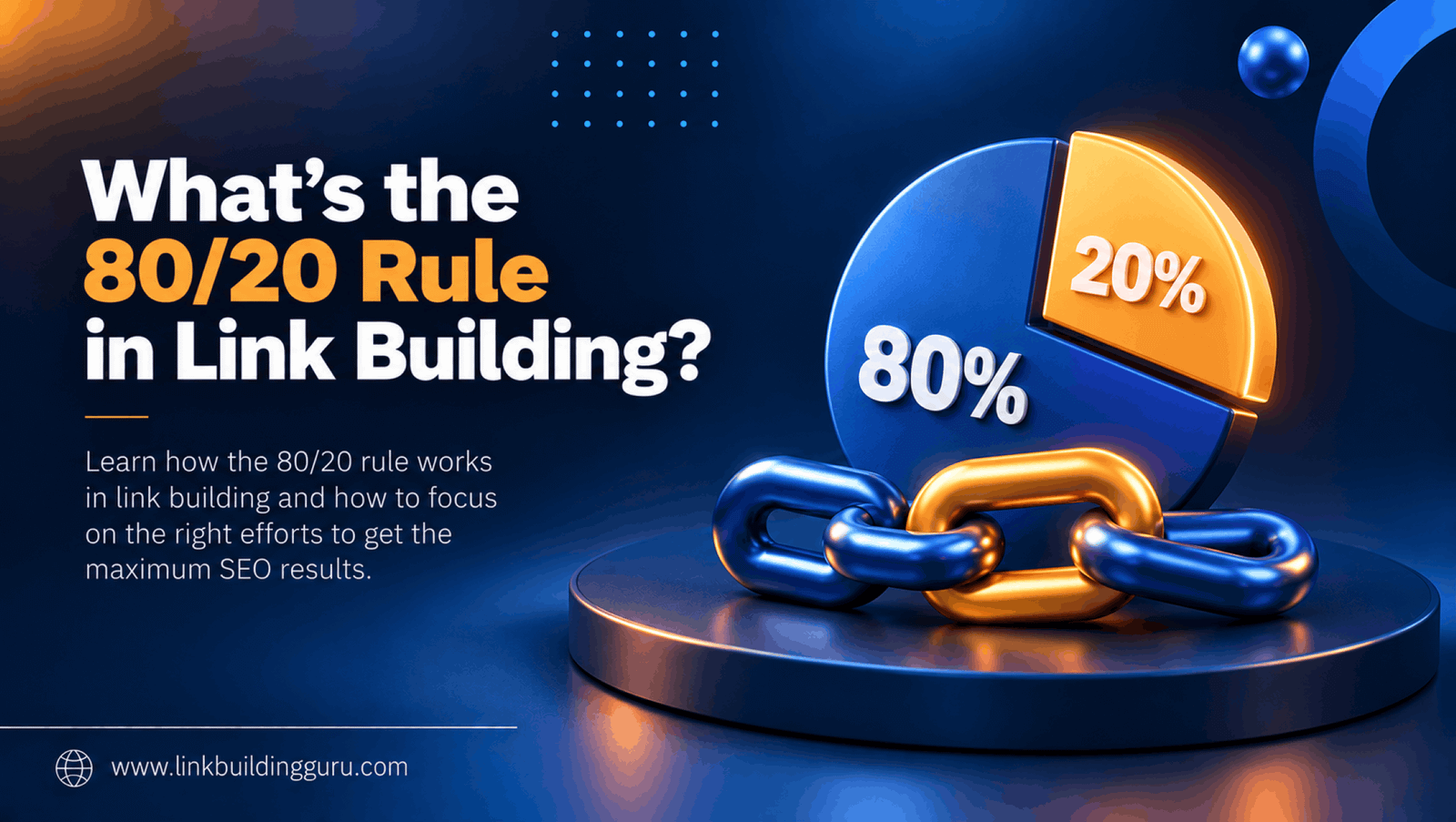
The answer is simple yet powerful. About 80% of your ranking improvements come from just 20% of your backlinks. This means most links in your profile do very little. A small handful of high-quality links drive almost all your organic growth.
Understanding this principle can save you time, money, and frustration. Let’s explore how to apply it to your link building strategy.
Understanding the 80/20 Rule (Pareto Principle)
The 80/20 rule, also called the Pareto Principle, states that 80% of outcomes come from 20% of efforts. Italian economist Vilfredo Pareto first observed this pattern in 1896 when studying wealth distribution.
This principle applies to nearly every field. In sales, 80% of revenue often comes from 20% of customers. In software, 80% of errors come from 20% of bugs. The exact ratio varies, but the core idea remains consistent.
For link building, the implications are huge. If you’re building 100 links per month, roughly 20 of them likely produce most of your results. The other 80 links? They might help a little, but their impact pales in comparison.
This insight should change how you approach link building and why your business needs it. Quality beats quantity every single time.
Why the 80/20 Rule Matters for Link Building
Many website owners chase link quantity. They measure success by counting backlinks. More must be better, right? Wrong.
Google’s algorithm has evolved significantly. It now evaluates link quality with remarkable precision. A single link from an authoritative, relevant website can outperform hundreds of low-quality links.
The Hidden Cost of Chasing Quantity
Building lots of mediocre links wastes resources. Think about the time spent on outreach emails. Consider the money paid for placements. Factor in the effort to create content for guest posts.
When you spread these resources across 100 low-value opportunities, you dilute your impact. But when you focus on 20 exceptional opportunities, you concentrate your power where it matters most.
This explains why your competitors rank with fewer backlinks than you. They likely understand the 80/20 rule. They target high-impact links while you chase volume.
What Makes a Link Part of the Valuable 20%?
Not all backlinks are created equal. The top 20% of links typically share these characteristics:
- High domain authority: Links from established, trusted websites carry more weight
- Strong topical relevance: The linking site covers topics related to yours
- Editorial placement: The link appears naturally within quality content
- Traffic potential: The page actually sends visitors to your site
- Contextual fit: The surrounding text relates to your linked page
Learning how to evaluate a backlink before you build it helps you identify these high-value opportunities.
How to Apply the 80/20 Rule to Your Link Building Strategy
Now let’s get practical. Here’s how to restructure your approach around the Pareto Principle.
Step 1: Audit Your Existing Backlink Profile
Start by analyzing your current links. Use tools like Ahrefs, Semrush, or Moz to examine your backlink profile. Look for patterns in your most valuable links.
According to 1Solutions, regular backlink audits help identify which link sources drive the most organic traffic and rankings improvements.
Ask these questions:
- Which links send actual referral traffic?
- Which links appeared before your biggest ranking jumps?
- What do your best-performing links have in common?
Step 2: Identify Your Ideal Link Targets
Based on your audit, create a profile of your “perfect” link. This becomes your template for prospecting.
Focus on sites that match your ideal link criteria. Build a smaller, curated list of prospects rather than a massive database of mediocre options.
Understanding backlink relevance vs domain authority helps you prioritize the right targets.
Step 3: Invest More in Each Opportunity
Here’s where the 80/20 rule really pays off. Instead of sending 100 template emails, send 20 personalized pitches. Instead of writing generic guest posts, create exceptional content that genuinely helps the target audience.
The math works in your favor. Spending five times more effort per prospect usually yields more than five times better results. Quality outreach converts better than spray-and-pray tactics.
Step 4: Track and Optimize
Monitor which links produce results. Track rankings, traffic, and conversions. Over time, refine your understanding of what constitutes your valuable 20%.
The 80/20 distribution isn’t fixed. As you improve your targeting, you might find that 30% of your links produce 90% of results. That’s progress.
Practical 80/20 Link Building Tactics
Let’s explore specific tactics that align with the 80/20 philosophy.
Digital PR for High-Impact Links
One mention in a major publication can outweigh dozens of smaller placements. Digital PR focuses on earning coverage from authoritative news sites and industry publications.
Compare this approach by exploring digital PR vs traditional link building to see which builds more authority for your specific situation.
Strategic Guest Posting
Guest posting still works when done right. The key is selectivity. Target publications with engaged audiences and high editorial standards.
Experts at The SEO Doctors recommend focusing on guest posting opportunities that align with your brand’s expertise and target audience for maximum impact.
Learn more about whether guest posts are still worth it in 2026 and what actually works today.
Broken Link Building
This tactic perfectly embodies the 80/20 rule. You find broken links on authoritative sites and offer your content as a replacement. One successful placement can be worth dozens of directory submissions.
Master this technique with our guide on how to use broken link building effectively.
Resource Link Building
Creating genuinely useful resources attracts links naturally. A comprehensive guide, original research, or free tool can earn backlinks for years. The initial investment is higher, but the returns compound over time.
Common Mistakes When Applying the 80/20 Rule
Watch out for these pitfalls as you implement this strategy.
Mistake 1: Ignoring the Other 80%
The 80/20 rule doesn’t mean you should completely ignore lower-value links. A natural backlink profile includes variety. Some smaller links provide diversity and context that Google expects to see.
Mistake 2: Obsessing Over Metrics Alone
Domain authority and similar metrics are useful but imperfect. A DA 40 site in your exact niche often beats a DA 70 site in an unrelated field. Consider relevance alongside raw metrics.
Mistake 3: Moving Too Slowly
Quality focus shouldn’t become an excuse for inaction. You still need consistent link building activity. Aim for fewer, better links, but keep the momentum going.
According to research from Moz’s link building guide, consistent link acquisition signals ongoing relevance to search engines.
Mistake 4: Skipping Relationship Building
The best links often come from relationships. Building genuine connections with industry peers, journalists, and content creators creates ongoing opportunities. These relationships represent your high-value 20%.
Measuring Your 80/20 Link Building Success
How do you know if you’re successfully applying the Pareto Principle? Track these metrics:
- Referring domains growth: Are you gaining links from diverse, authoritative sources?
- Organic traffic correlation: Which new links precede traffic increases?
- Keyword ranking movements: Track rankings for target keywords after link acquisition
- Referral traffic: Which links send actual visitors?
- Resource efficiency: Cost per valuable link acquired
According to Backlinko’s comprehensive research, websites that focus on acquiring high-quality links see faster ranking improvements than those chasing quantity.
Frequently Asked Questions
What’s the 80/20 rule in link building exactly?
The 80/20 rule in link building means that approximately 80% of your SEO results come from just 20% of your backlinks. This principle encourages focusing on acquiring fewer, higher-quality links rather than building large quantities of mediocre ones.
How do I identify which links are in my valuable 20%?
Analyze your backlink profile using SEO tools. Look for links that preceded ranking improvements, send referral traffic, come from authoritative sites in your niche, and appear in contextually relevant content. These typically represent your high-value links.
Should I stop building low-quality links entirely?
Not completely. A natural backlink profile includes variety. However, you should shift your focus and resources toward high-impact opportunities. Allocate most of your budget and effort to quality links while maintaining some diversity.
How many links should I aim to build each month?
Focus on value rather than volume. Ten high-quality links often outperform one hundred weak ones. Start by identifying what “quality” means for your specific niche and target those opportunities consistently.
Does the 80/20 rule apply to all industries?
Yes, but the specific definition of “quality” varies by industry. In competitive niches, you might need higher authority links. In local businesses, relevant local links matter more. Adapt the principle to your context.
How long before I see results from focusing on quality?
Quality-focused link building typically shows results within three to six months. Initial progress may seem slower than quantity-based approaches, but the gains are more substantial and sustainable over time.
Can I apply the 80/20 rule to other SEO activities?
Absolutely. The Pareto Principle applies across SEO. A small percentage of your keywords likely drive most traffic. A handful of pages probably generate most conversions. Apply this thinking to prioritize all your SEO efforts effectively.