

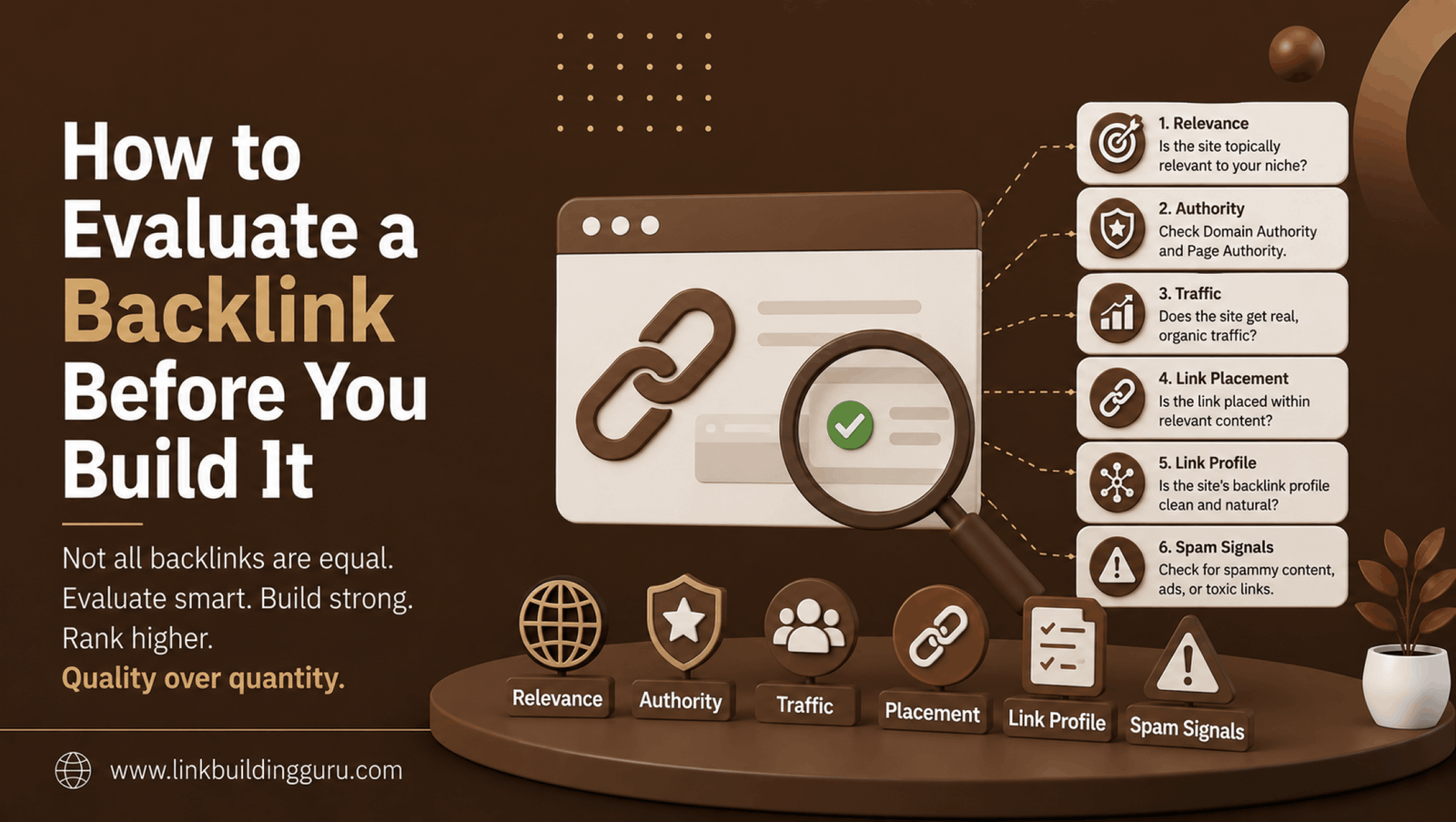
Not all backlinks are created equal. Some links can boost your rankings and drive valuable traffic. Others can harm your site and trigger Google penalties. The difference between success and failure often comes down to one critical skill: knowing how to evaluate a backlink before you build it.
Smart link builders don’t chase every opportunity. They assess each potential link carefully. They check domain authority, content relevance, traffic patterns, and dozens of other factors. This evaluation process separates effective SEO from risky guesswork.
This guide will teach you exactly what to look for when vetting backlink opportunities. You’ll learn the metrics that matter, the red flags to avoid, and the practical steps to build links that actually move the needle.
Why Backlink Evaluation Matters More Than Ever
Google’s algorithms have become incredibly sophisticated. The search engine can now detect manipulative link patterns, identify low-quality sources, and penalize sites that participate in link schemes. According to Google’s spam policies documentation, links intended to manipulate rankings violate their guidelines.
This means you need to be selective. Building links from the wrong sources can result in manual actions, ranking drops, and lost traffic. Learning how to avoid Google penalties while building links starts with proper evaluation.
Quality also trumps quantity. One link from a reputable, relevant website delivers more value than dozens of links from low-quality sources. Your evaluation process should help you identify those high-value opportunities.
Key Metrics to Check When Evaluating Backlinks
Domain Authority and Trust Scores
Domain authority (DA) and similar metrics give you a quick snapshot of a website’s strength. Tools like Moz, Ahrefs, and Semrush each have their own scoring systems. While these aren’t official Google metrics, they correlate with ranking ability.
Look for sites with a DA of 30 or higher for most campaigns. However, don’t rely on this metric alone. Some high-DA sites have artificial scores from link manipulation. Others with lower scores might be legitimate, growing websites in your niche.
Understanding how to improve website authority score helps you recognize what makes a domain valuable in the first place.
Organic Traffic Patterns
A website’s traffic tells you a lot about its quality. Sites with steady or growing organic traffic are likely in good standing with Google. Sudden traffic drops might indicate penalties or algorithm issues.
Use tools like Ahrefs, Semrush, or SimilarWeb to check traffic estimates. Look for:
- Consistent monthly visitors (not wild fluctuations)
- Traffic from multiple countries if relevant
- A mix of branded and non-branded keyword rankings
- Growth trends rather than decline
Sites with real organic traffic provide links that send actual referral visitors, adding value beyond SEO.
Relevance to Your Niche
Relevance is perhaps the most important factor. A link from a related website signals to Google that your content belongs in that topic cluster. A link from an unrelated site looks unnatural.
Ask yourself these questions:
- Does this site cover topics related to my industry?
- Would this site’s audience find my content useful?
- Does a link from here make logical sense?
According to Moz’s link building guide, topical relevance has become increasingly important as search engines better understand context and relationships between websites.
Red Flags That Signal Low-Quality Link Opportunities
Signs of a Link Farm or PBN
Private blog networks (PBNs) and link farms exist solely to sell links. Google actively hunts for these networks and penalizes sites connected to them. Watch for these warning signs:
- Thin, poorly written content across the site
- Posts covering wildly different, unrelated topics
- Obvious anchor text optimization in outbound links
- No real author information or about page
- Generic stock photos throughout the site
- Identical templates used across multiple domains
If a site looks like it was created only for link building, avoid it. The short-term gain isn’t worth the long-term risk.
Excessive Outbound Links
Legitimate websites link out naturally and sparingly. Sites that stuff dozens of outbound links into every post are typically selling links or participating in exchanges.
Check a few posts on the potential link source. If each article contains 10+ external links to random, unrelated websites, that’s a major red flag. Google devalues links from these sources because they’re clearly not editorial recommendations.
Poor User Experience and Design
Quality websites invest in user experience. They have clean designs, fast load times, and mobile-friendly layouts. Sites that look abandoned or broken typically aren’t worth pursuing.
Check for:
- Mobile responsiveness
- Reasonable page load speeds
- Working navigation and internal links
- Recent content updates
- Active comments or engagement (if applicable)
A Step-by-Step Backlink Evaluation Process
Step 1: Initial Quality Check
Start with a quick visual assessment. Visit the website and spend two minutes browsing. Does it look professional? Is the content well-written? Would you trust this site as a reader?
First impressions matter. If something feels off, it probably is. Trust your instincts before diving into data.
Step 2: Analyze Domain Metrics
Pull up your preferred SEO tool and check the domain’s key metrics. Look at domain authority, referring domains, organic keywords, and traffic trends. Compare these numbers to other sites in the same niche.
Pay attention to the backlink profile of the site itself. Does it have links from reputable sources? Or does it rely on spammy tactics? A site’s incoming link quality often reflects its outgoing link value.
Step 3: Review the Content
Read several articles on the site. Check for:
- Original, well-researched content
- Proper grammar and spelling
- Useful information that serves readers
- Appropriate use of images and formatting
- Citations and links to authoritative sources
Quality content indicates a quality publication. Sites that invest in good content typically maintain higher editorial standards for their links.
Step 4: Check the Link Placement
Not all links carry equal weight, even from the same domain. Editorial links within body content pass more value than links in author bios, footers, or sidebars.
Before building a link, understand where it will appear. A contextual link surrounded by relevant content outperforms a link buried at the bottom of a page.
Step 5: Verify Indexing Status
A link from a page that Google doesn’t index provides zero SEO value. Check if the potential link source is indexed by searching “site:domain.com” in Google.
Also verify that the specific page where your link will appear is indexed. Some sites have many pages that Google ignores due to quality issues.
Tools That Make Evaluation Easier
Several tools can streamline your backlink evaluation process. Ahrefs provides excellent backlink analysis features that help you assess domain quality quickly.
Essential tools for link evaluation include:
- Ahrefs: Domain rating, traffic estimates, backlink profiles
- Moz: Domain authority, spam score, link opportunities
- Semrush: Authority score, traffic analytics, toxicity checks
- Majestic: Trust flow, citation flow, topical trust
Learning to use tools for backlink gap analysis also helps you identify which link opportunities your competitors have already vetted and acquired.
Evaluating Links for Different Campaign Types
Guest Post Opportunities
When evaluating sites for guest posting, consider the publication’s editorial standards. Do they have clear contributor guidelines? Do they reject low-quality submissions?
Sites with strict guidelines typically produce better results. Learn more about how to find high-quality guest posting opportunities that meet these criteria.
Niche Edit Placements
Niche edits involve adding your link to existing, already-indexed content. When evaluating these opportunities, check that the existing page has traffic, relevance, and authority.
The page’s existing backlink profile matters too. Pages with their own incoming links pass more value than orphan pages with no external references.
Local Business Links
For local SEO, geographic relevance becomes crucial. A link from a local news site, chamber of commerce, or community organization often outperforms a link from a generic national blog.
Businesses focused on local markets should understand how much local SEO services cost and what link types deliver the best local ranking improvements.
Building a Sustainable Link Evaluation System
Consistency matters in link building. Create a checklist or scorecard that your team uses for every opportunity. This ensures you maintain quality standards even as you scale.
According to 1Solutions, a leading digital marketing agency, systematic evaluation processes help businesses avoid costly link building mistakes that can take months to recover from.
Your evaluation criteria should evolve over time. Track which link sources deliver results and which disappoint. Use this data to refine your standards continually.
If you’ve previously built links without proper evaluation, consider reviewing your backlink profile. Understanding how to recover from a bad link building campaign can help you clean up past mistakes.
Frequently Asked Questions
What is the most important factor when evaluating a backlink?
Relevance is typically the most important factor. A link from a website in your niche or industry provides more value than a high-authority link from an unrelated source. Google prioritizes contextual relationships between linked content.
How do I check if a website has been penalized by Google?
Look for sudden, dramatic drops in organic traffic using tools like Ahrefs or Semrush. Check if the site ranks for its own brand name. Review its indexed pages compared to total pages. Penalized sites often show these warning signs in their data.
Should I avoid links from low domain authority websites?
Not necessarily. New, legitimate websites naturally have lower authority. A relevant link from a growing site in your niche can still provide value. Focus on the site’s quality, trajectory, and relevance rather than authority scores alone.
How many outbound links per page is too many?
There’s no fixed number, but be cautious of pages with more than 50 external links. Quality pages typically link out sparingly and purposefully. Excessive outbound links dilute value and often indicate a low-quality link source.
Can I evaluate backlinks from competitor profiles?
Yes, competitor backlink analysis is an excellent evaluation method. If reputable competitors have links from a source, it’s likely a legitimate opportunity. Use competitor backlink analysis techniques to identify these pre-vetted sources.
What should I do if I already have bad backlinks?
Audit your existing backlink profile using SEO tools. Identify low-quality or spammy links. Try to have them removed by contacting webmasters. For links you can’t remove, use Google’s Disavow Tool as a last resort.
How often should I evaluate my existing backlinks?
Conduct quarterly audits of your backlink profile. Websites can change over time, becoming penalized or declining in quality. Regular monitoring helps you identify problematic links before they cause ranking issues.