

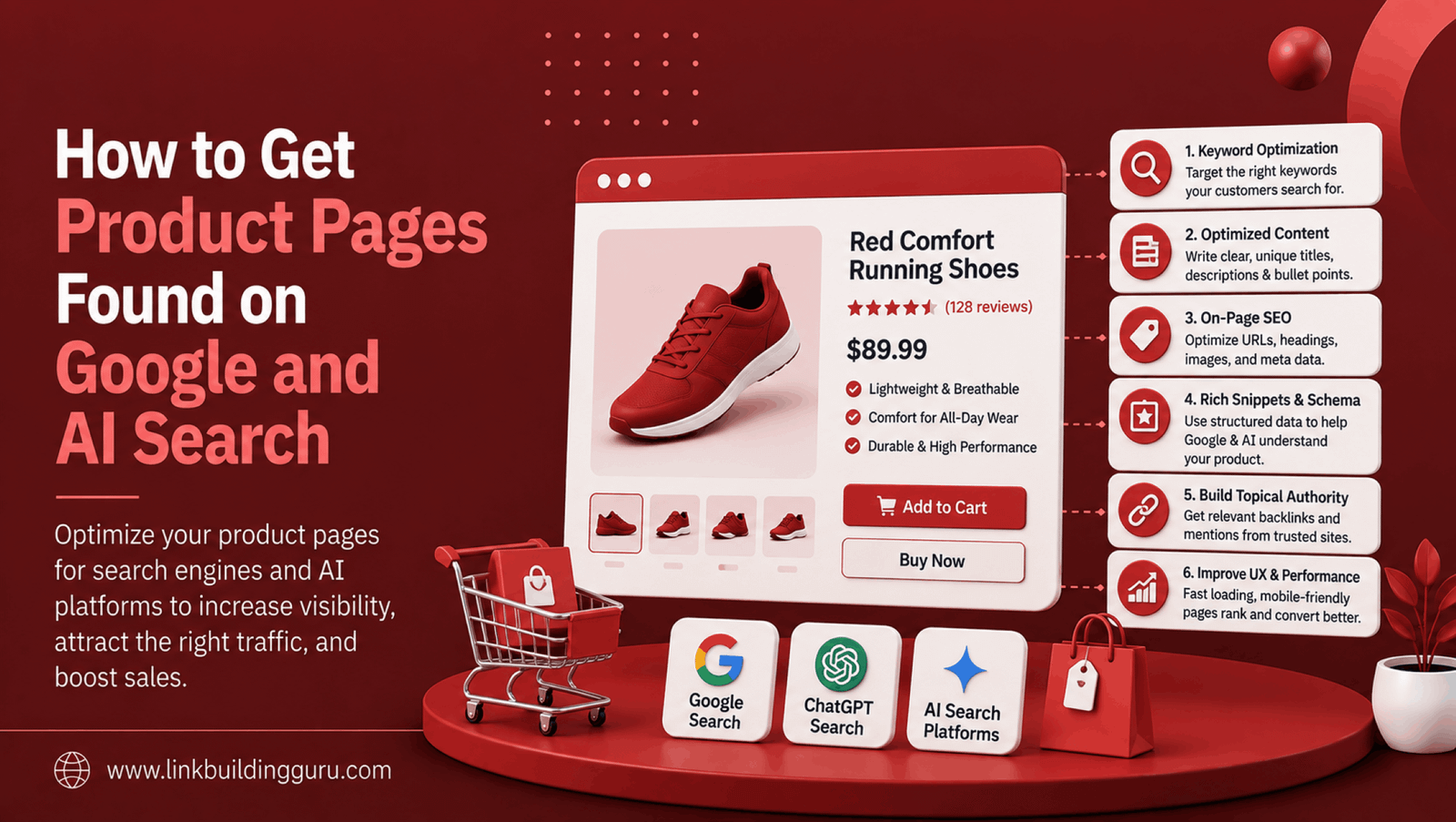
Your product pages are the heart of your online store. They showcase what you sell and convert browsers into buyers. But here’s the problem: most product pages never get seen by potential customers.
Why? Because they’re invisible to both Google and AI search tools like ChatGPT, Perplexity, and Google’s AI Overviews.
Learning how to get product pages found on Google and AI search is now essential for any ecommerce business. The search landscape has changed dramatically. You need to optimize for traditional search engines AND the new wave of AI-powered discovery tools.
This guide breaks down the exact steps you need to take. We’ll cover proven SEO tactics, AI optimization strategies, and link building techniques that will put your products in front of ready-to-buy customers.
Why Product Pages Struggle to Rank
Before we fix the problem, let’s understand it. Product pages face unique challenges that blog posts and service pages don’t.
First, they often have thin content. A product name, price, and a few bullet points won’t impress Google or AI tools. Second, they compete against major retailers with massive domain authority. Third, many stores have dozens or hundreds of similar product pages, creating internal competition.
According to 1Solutions, most ecommerce sites see less than 20% of their product pages receiving organic traffic. The rest sit in search engine obscurity.
The good news? You can fix this with the right approach. Understanding SEO metrics that actually matter helps you focus your efforts where they’ll make the biggest impact.
Optimize Product Page Content for Search Engines
Great product page SEO starts with content. Here’s how to create pages that both Google and customers love.
Write Unique, Detailed Product Descriptions
Stop copying manufacturer descriptions. Everyone else uses them, which means duplicate content issues and zero competitive advantage.
Instead, write original descriptions that:
- Answer common customer questions
- Highlight key benefits, not just features
- Include relevant keywords naturally
- Tell a story about the product’s use
- Address potential objections
Aim for at least 300 words per product page. More content gives search engines more to work with and helps customers make informed decisions.
Optimize Title Tags and Meta Descriptions
Your title tag is prime real estate. Include your primary keyword, product name, and brand. Keep it under 60 characters so Google doesn’t cut it off.
For meta descriptions, write compelling copy that encourages clicks. Include your target keyword and a clear value proposition. Think of it as a mini advertisement for your product.
Use Schema Markup
Schema markup helps search engines understand your product pages better. It can also earn you rich snippets in search results, including star ratings, prices, and availability.
Implement Product schema at minimum. Add Review schema if you have customer reviews. This structured data is crucial for GEO (Generative Engine Optimization), which helps AI tools understand and recommend your products.
Technical SEO for Product Pages
Technical issues can tank your product page visibility. Here’s what to check and fix.
Speed and Mobile Performance
Google uses page speed as a ranking factor. AI tools also prefer fast-loading sources. Google’s PageSpeed Insights can identify specific issues slowing down your product pages.
Common fixes include:
- Compressing product images without losing quality
- Using lazy loading for images below the fold
- Minimizing JavaScript that blocks rendering
- Enabling browser caching
Fix Crawlability Issues
Search engines can’t rank pages they can’t find. Make sure your product pages are:
- Not blocked by robots.txt
- Included in your XML sitemap
- Free from 404 errors that frustrate users and bots
- Using canonical tags correctly to avoid duplicate content
Improve Internal Linking
Internal links distribute authority throughout your site. They also help search engines discover and understand your product pages.
Link to products from related blog posts, category pages, and other product pages. Use descriptive anchor text that includes relevant keywords. Our guide on using internal linking to support external links explains this strategy in depth.
Build Quality Backlinks to Product Pages
Backlinks remain one of the strongest ranking factors. Getting links directly to product pages is challenging but possible.
Create Linkable Product Content
Give people a reason to link to your product pages. Add valuable content like:
- Detailed buying guides
- Comparison charts
- How-to videos showing the product in action
- Original research or statistics about your product category
The experts at The SEO Doctors recommend creating “link-worthy” elements on each product page that journalists and bloggers want to reference.
Pursue Product Reviews and Mentions
Reach out to bloggers, YouTubers, and industry publications who review products in your niche. Offer free samples in exchange for honest reviews. These reviews often include links back to your product pages.
For a comprehensive approach, explore link building strategies for ecommerce websites that have proven results.
Leverage Supplier and Manufacturer Relationships
If you sell branded products, ask manufacturers to list you as an authorized retailer. Many brands have dealer pages with links to their partners. These links carry significant authority.
Optimizing for AI Search Engines
AI search tools like ChatGPT, Perplexity, and Google’s AI Overviews are changing how people discover products. Here’s how to get your product pages found in these new search environments.
Understand How AI Search Works
AI tools pull information from across the web to answer questions. They prioritize sources that are:
- Authoritative and well-cited
- Clear and well-structured
- Comprehensive in answering user queries
- Updated recently
Understanding link building strategies for AI SEO gives you an edge in this new landscape.
Answer Questions Directly on Product Pages
AI tools love content that directly answers questions. Add FAQ sections to your product pages that address common queries like:
- What is this product best used for?
- How does it compare to alternatives?
- What are the key specifications?
- Who should buy this product?
According to Search Engine Land, content that directly answers questions has a higher chance of being featured in AI-generated responses.
Build Topical Authority
AI tools favor sources that demonstrate expertise in their niche. Create supporting content around your products, including blog posts, guides, and comparison articles.
This content builds topical authority that benefits your entire site. Learn how to improve your website authority score for better results across all search types.
Get Mentioned Across the Web
AI tools learn from millions of web pages. The more your brand and products get mentioned on reputable sites, the more likely AI will recommend you.
Focus on earning mentions through:
- Press releases for new products
- Guest posts on industry blogs
- Podcast appearances
- Social media engagement
- Industry forums and communities
Track and Measure Your Results
You can’t improve what you don’t measure. Set up tracking to monitor your product page visibility.
Use Google Search Console to track impressions, clicks, and average position for product pages. Monitor which queries bring traffic and optimize accordingly.
For AI search visibility, track brand mentions using tools like Mention or Google Alerts. Watch for your products appearing in AI-generated responses by regularly searching relevant queries.
Understanding how to calculate and measure SEO ROI helps you justify your optimization efforts and secure resources for continued improvement.
Frequently Asked Questions
How long does it take for product pages to rank on Google?
Product pages typically take 3 to 6 months to see significant ranking improvements. New domains may take longer. Consistent optimization, fresh content updates, and quality backlinks can speed up the process.
Do I need to optimize every product page individually?
Yes, each product page needs unique optimization. However, you can create templates for titles, descriptions, and structure. Focus extra effort on your best-selling and highest-margin products first.
How do AI search engines find product information?
AI search engines crawl the web and pull information from authoritative sources. They use product schema, reviews, specifications, and mentions across multiple sites to understand and recommend products.
Are backlinks still important for product page SEO?
Absolutely. Backlinks remain one of the top ranking factors. For product pages specifically, links from review sites, industry publications, and relevant blogs carry significant weight for both Google and AI search.
Should I create separate pages for product variations?
It depends on the variations. If they target different keywords (like “blue running shoes” vs “red running shoes”), separate pages make sense. For minor variations, use a single page with options to avoid thin content issues.
How do I get my products into Google Shopping results?
Set up a Google Merchant Center account and submit your product feed. Ensure your product pages have accurate pricing, availability, and images. Use Product schema markup to provide structured data Google needs.
What’s the best way to handle out-of-stock products for SEO?
Keep the page live with a note about availability. Offer alternatives or let customers sign up for restock notifications. Removing pages creates 404 errors and loses any SEO value the page has built.